MACHINE ATTACHMENTS
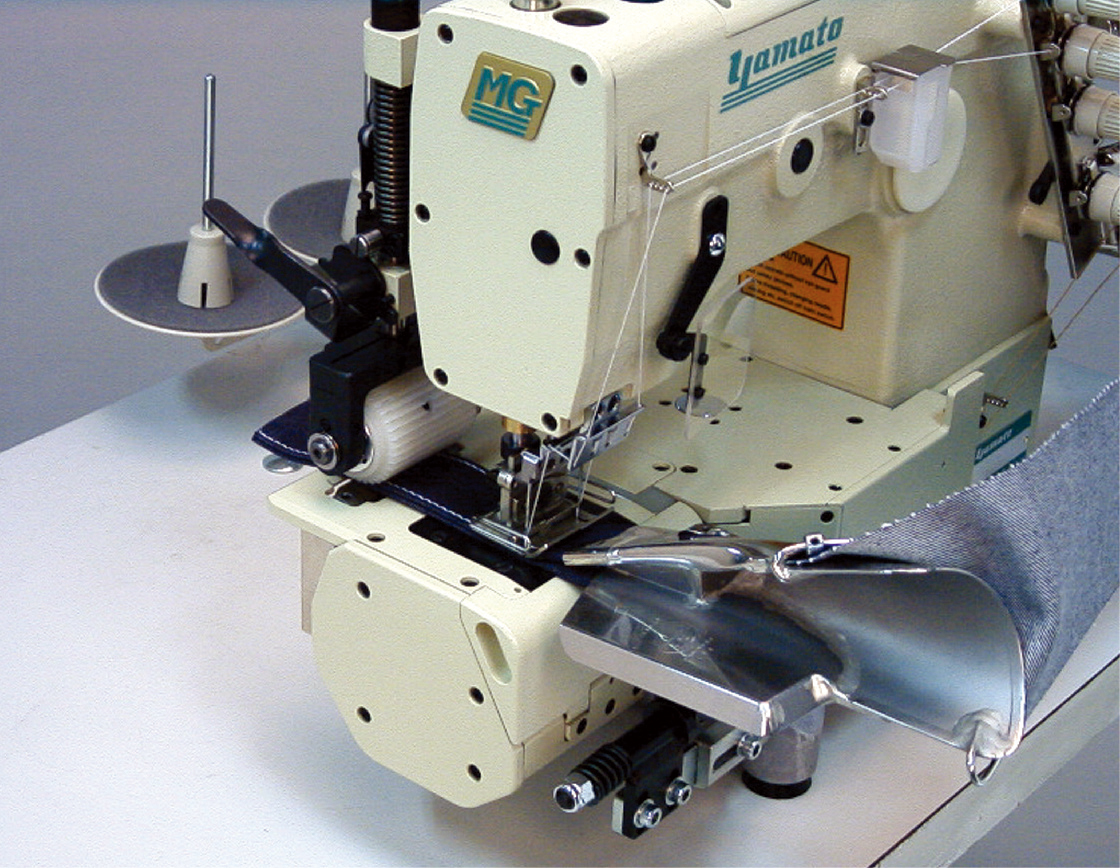
Generally sewing attachment means sewing machine parts and accessories. Sewing machine attachments make sewing machines easier and provide a variety of decorative sewing possibilities. These machine attachments never change original frame of machine. There are three main types of sewing machine attachments.
- Position Attachments
- Guide Attachments
- Preparation and Finishing Attachments
- POSITION ATTACHMENTS
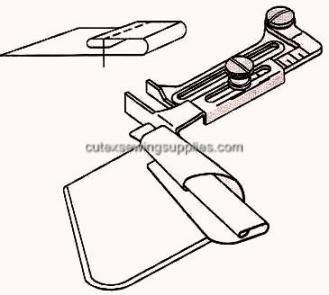
Hemmers construct hems from 3/16" to 7/8" wide, right to the sewing machine. This saves a lot of time as no need to hand turn the fabrics fir hemming.
The ruffler attachment has the capacity of doing gathering or pleated frill.
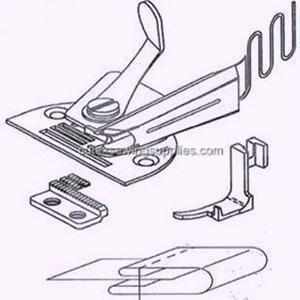
The binder attachment has a small funnel-like portion for folding and guiding the binding over the edge of the fabric.
This attachment is used for creating uniform tucks from 1/8″ to 1″ width.
The gathering foot attachment is used for making soft gathers swiftly particularly in lightweight fabrics.
2. GUIDE ATTACHMENTS
The zipper foot could be set to stitch on both sides of the zipper. The edge of the foot directs the zipper to make sure placement is straight.
It i used to grip the fine cords or threads. A range o functional or decorative stitches could be sewn over the cords to put them onto base fabrics.
The circular attachment is the most suitable one for sewing of circles using straight, zigzag or decorative stitches. Circles up to 26 cm in diameter can be stitched perfectly using this attachment, which is vital for craft and decorative work.
The two bars in the button sewing foot are fixed to the shank of the presser foot to give additional firmness and it has a rubber sleeve for better gripping of the button during sewing.
With the buttonhole foot (Figure-14), which is secured to the buttonhole stabiliser plate, the machine feeds a range of fabrics and uneven layers smoothly instead of causing the needle to stick in position.
The buttonhole foot is used for sewing buttonholes on the fabric. Two kinds of buttonhole foot are available, namely, transparent buttonhole foot and sliding buttonhole foot. The transparent buttonhole foot is used for stitching buttonholes on tight zones like cuffs and a sliding-type foot is used for stitching buttonholes on areas where more freedom of movement is essential.
3. PREPARATION AND FINISHING ATTACHMENTS
It is a common finishing operation on garments. A power pinker is normally used for this purpose or pinking mechanism could be attached to the sewing machine. The two major actions carried out by the pinker are chopping and cutting.
It is used for finishing garments after the fabric is sewed. For example, on a belt loop attachment process where a flat iron or rotary press pressing device is attached to the machine head.
These are extensively required alternatives that minimize production time and get rid of manual thread clipping. On a few machines, sewing threads are cut beneath the throat plate, and a wiper pulls the residue portion of cut thread out of the way in preparation for the next process.
The chain cutters cut the chains in such a way that the stitch is secured against unraveling. Stitches produced on these machines cannot be cut as close as like in lock stitch machines, and some remnant thread remains.
It could be used with the application of shoulder reinforcements, neck bindings, elastic, lace and so on. As stitching is finished, a photocell sensor finds the fabric end or piece and connects the cutter automatically. Tape may be cut at the beginning and end of the garment piece.
NEEDLE AND STITCH DEVICES
On several sewing machines, options are designed especially for assisting in the construction of the perfect line of stitches such as needle positioned and stitch pattern regulators.
Comments
Post a Comment